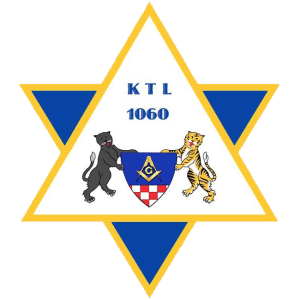
How the coat of arms is composed
At its centre is a shield divided into two fields: above, the square and compasses with the letter G on a blue ground; below, a red and white chequered pattern. It is held by a black panther and a tiger and surrounded by a blue and gold frame bearing the initials KTL and the lodge number 1060.
Square, compasses and G
The upper field shows the square and compasses, the best-known symbols of freemasonry, and so stands for the “Royal Art”, as freemasonry is traditionally called. The square stands for uprightness and the right measure in dealing with other people, the compasses for the limits we set ourselves. The letter G is traditionally linked to geometry, the foundation of the builder’s art, and at the same time to the Great Architect of the Universe, as freemasons call the Supreme Being.
The red and white chequers
The lower field takes up an image every freemason knows from the temple. Its floor is laid out like a chessboard, and this so-called mosaic pavement stands for the contrasts of life, for light and shadow, joy and sorrow, all of which are equally part of human existence. There is a second reason why the chequers in our coat of arms are red and white: they recall the red and silver chequers of the former County of Mark, to which Unna belonged, the town where our lodge was founded.
Panther and tiger
The shield is held by a black panther and a tiger, and both point to Kurt Tucholsky. As Peter Panter he published columns and reviews, as Theobald Tiger he wrote poems and chansons. In this way the coat of arms quite literally carries the man whose name we bear.