A voice of the Weimar Republic
Kurt Tucholsky was one of the most important writers and journalists of the Weimar Republic. With a sharp pen he wrote poems, chansons, satirical columns, reviews and political essays. He spoke out against militarism, nationalism and a judiciary that turned a blind eye to the political right, and he warned early and urgently against National Socialism. At the same time he was a fine observer of everyday life and wrote light-hearted stories such as “Rheinsberg” and “Castle Gripsholm”.
His life
- 1890Born in BerlinKurt Tucholsky is born in Berlin on 9 January 1890, the son of a Jewish banker.
- 1909StudiesHe begins studying law in Berlin and Geneva.
- 1915Doctorate and military serviceTucholsky completes his studies with a doctorate “cum laude”. During the First World War he is called up to the army.
- 1918Editor-in-chief of “Ulk”In Berlin he becomes editor-in-chief of the magazine “Ulk” and one of the most influential voices of the Weimar Republic.
- 1924ParisTucholsky lives in Paris as correspondent for the “Weltbühne” and the “Vossische Zeitung”. In the same year he becomes a freemason.
- 1926The “Weltbühne”After the death of Siegfried Jacobsohn he briefly takes over as editor of the “Weltbühne”, before Carl von Ossietzky continues it.
- 1933Book burning and loss of citizenshipHis books are among the first to be burned by the National Socialists. By then Tucholsky is already living in Sweden; later that year he is stripped of his German citizenship.
- 1935Death in exileKurt Tucholsky dies in Gothenburg in December 1935. His grave lies in Mariefred, near Gripsholm Castle.
Kurt Tucholsky as a freemason
On 24 March 1924 Tucholsky was initiated in Berlin into the lodge “Zur Morgenröte”, which belonged to the masonic association “Zur aufgehenden Sonne”. Shortly afterwards he went to Paris as a correspondent.
On 11 December 1925 he was raised to the degree of Master Mason there, in the lodge building in the Avenue de Suffren, together with eleven other members of the lodge “Les Zélés Philanthropes” (“The Zealous Philanthropists”). In the same year he became a member of the Paris lodge “L’Effort” (“The Endeavour”). His membership card of this lodge has survived.
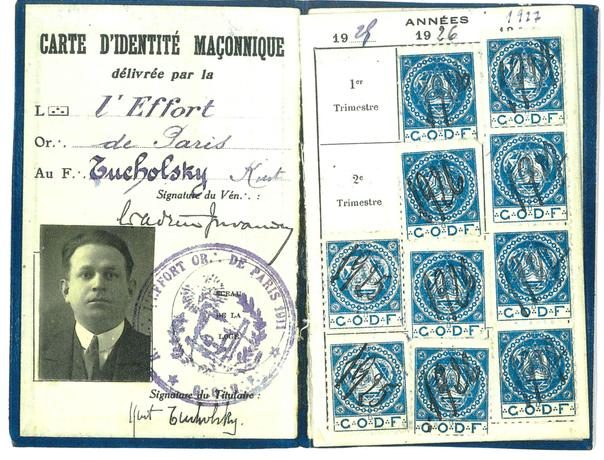
Tucholsky’s membership card of the lodge “L’Effort”, Paris
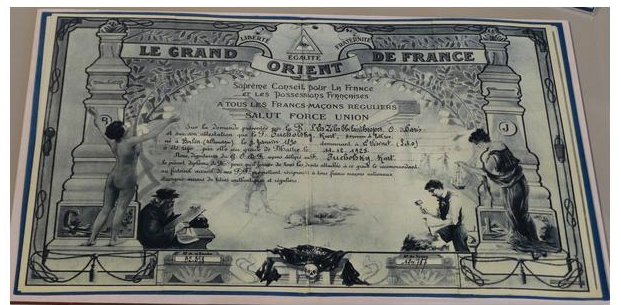
Masonic certificate of the Grand Orient de France
Five names
Tucholsky wrote not only under his own name but also under four pseudonyms, each standing for a voice of its own: Ignaz Wrobel for sharp political pieces, Peter Panter for columns and reviews, Theobald Tiger for poems and chansons, and Kaspar Hauser for thoughtful, often melancholy reflections. He himself joked that he was a man “with five PS”, playing on the German abbreviation for horsepower.
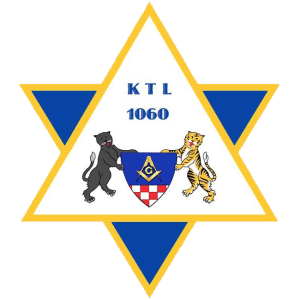
Two of these names have taken shape in our lodge’s coat of arms: the black panther and the tiger hold the shield with square and compasses.
Why this name?
With its name, our lodge remembers a freemason who stood for free thought, for tolerance and for the courage to speak uncomfortable truths. Tucholsky did not merely describe this attitude, he lived it in his writing, often against considerable resistance and in the end at the price of exile. We see in this a close kinship with the values of freemasonry, and it remains an inspiration to us today.
At the same time his name reminds us that seriousness and humour do not exclude each other. Having a satirist as our namesake is also an invitation to look at our own work with composure and to be able to laugh at ourselves.